
Glass, Leather, Gold
Tracing the garments that appear across mythic traditions that can be classified as Cinderella stories and examining the practices they inspired

Who can utter the words "Once Upon a Time" and not be reminded of Cinderella? The most popular of the modern-day princesses, due in no short part to Disney and its various films with the princess as their titular lead.

I’ve had my own obsessions with princesses. Not with wearing their ballgowns or dancing with the prince; that is far too mundane an activity to aspire to. I’ve long been fascinated by the luxuries that accompany their royal titles, and the curses that inevitably follow them. Sparkling, glittering diamonds that can be worn only by empresses, or jewels that inspire revolution, corsets that endure knife wounds, pearls that outlive dynasties and perfumes that are poison. And of course the glass slippers that lead to mutilated feet, slick with blood before the princess slipped them onto her own pristine, untouched feet. Enrobed in riches, cursed to die.
Fairytales reflect so much about history and customs at the time in which they are written. And Cinderellas in particular are abundant in cultures all around the world; I’ve read most of the stories, collecting them slowly. Dusty history books and my trusty tome of Grimms that narrates one of the most common iterations of the tale. And more often than not, I’m found drawn to the fashion described in these stories. These luxurious items that give each tale something unique. A tale can be told a thousand times, but it needs its own pair of… well, glass slippers, to be truly memorable.
The oldest written version of Cinderella was recorded by a Greek historian, Strabo, in the 1st century BCE. The skeleton of Strabo’s story followed a Thracian courtesan named Rhodopis. One day, an eagle snatched one of her plain leather sandals and carried it all the way to Memphis, and dropped it into the lap of a king who was holding court. The shape of the sandal was so beautiful it moved the king, and he sent his men in all directions across the globe in search of the woman who wore it. When he finally found her in Naucratis, he married her.
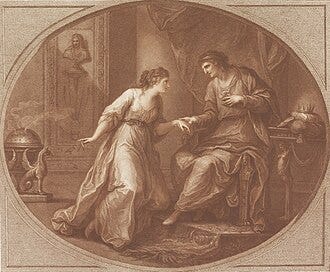
There is a plethora of debate that surrounds Rhodopis and her sandals - gold, gilded leather, or plain slippers. In a way, it is one of the best ways to see history adding layers to an event until it is not even fiction but mere myth.
Prior to Strabo writing her story, the myth of Rhodopis was being orally disapproved by Herodotus. Roughly a century after she had lived, people were claiming the third pyramid in Giza was built by the courtesan, and Herodotus went to great lengths to point out that the pharaohs who truly constructed the pyramids lived centuries before Rhodopis. He then went on to dive into the girl's ancestry, annoyed at the prospect of a magical sandal.
Rhodopis lived in Thrace; she was the slave girl of a slavemaster named Iadmon and was taken to Egypt during the reign of Pharaoh Amasis, where she was freed for a large sum by Charaxus of Mytilene. Charaxus was the brother of the poet Sappho. Rhodopis is associated with one of the most famous poets in the Greek canon. Sappho apparently mocked her own brother for squandering his fortune in buying Rhodopis' freedom, accusing her of robbing him. This fragmented poem still seemingly exists.

According to Herodotus, Rhodopis didn’t marry a king, but instead dedicated her newfound freedom and a portion of her earnings to buying a set of iron spits as a tribute to the Delphic oracle.
In Strabo's Geographica, almost half a millennium after Rhodopis's lifetime, is when the first elements of a Cinderella story appear. Strabo presents it as a fairytale tied to the pyramids near Memphis. Later, the Roman-era writer Aelian repeated it in his Miscellaneous History, which indicates that Strabo’s version had become the standard telling by late antiquity.
But what interests me more than any of this is what the myth indicates about fashion traditions in this area of the world at the time in which it was first written and the time in which it was later passed down.
Egyptian craftsmen really did make beautiful gilt leather sandals, and they were unambiguously a mark of the rich and royal.
Early Ancient Egyptian footwear was made from a range of materials — palm leaves, papyrus, leather, gemstones, and gold. Certain pairs, being made for the pharaohs and empresses, required entire teams of artisans. The golden funerary sandals were worn specifically by the wealthy and elite, sometimes paired with matching gold toe stalls for the mummy’s fingers and toes.
According to leatherworking specialist and historian André Veldmeijer, gilding of leather came into use in Egypt only in the Coptic Period, roughly the 3rd–7th centuries CE, hundreds of years after Rhodopis had died. Solid gold sandals existed far earlier, as seen in Tutankhamun’s tomb and the queens of Thutmose III, but gilt leather specifically appears to be a much later craft development, most likely at the time when Aelian reproduced the story. In a way, this was proof to me that myth-making happens at the level of material culture inspired by the world around and inspiring traditions to come.
Naucratis became famous specifically for its elaborate symposia and its beautiful hetairai, and for imports and exports into Egypt: wine, oil, silver, and perfume were the most decadent forms of currency at this time. The luxury economy of Naucratis ran on scent and silver, not footwear, and yet that is the mutated tale that has been passed down.
In ancient Greek society, hetaerae were required to wear distinctive dress and pay taxes, and unlike most other women in Greek society, there’s evidence they were educated; their role is often compared to the Japanese geisha. They occupied a distinct social position elevated above both prostitution and wifehood. Rhodopis wasn’t unique. Herodotus names only two hetaerae in his entire discussion of the occupation, Rhodopis and a second woman, Archidike. The famous beautiful courtesan of Naucratis held a recognised space in society that was official enough to require a dress code and a separate tax status.
The story’s central image is conceived by a later writer, guessing at what the most precious object would be based on what was valued at the time. These were ideas reverse-engineered in the story; the central character was now mired in gold and gilt when her real luxury items were most likely Naucratite perfume rather than a sandal.
Rhodopis’ sandal, be it leather, gold or gilt, was truly never about her. It was the historians an age later obsessing (as I do now) over the courtesan's fame and rare position and borrowing from history to fashion a fantastic story centred around what their idea of wealth was. And it is not a pattern that remained solely in Egypt. Hundreds of years from the age of Herodotus and Strabo, the sandals make their way across the world to the Far East, leaving a new trail behind them entirely constructed of gold and shattered bone.
In China, the fairy tale was written during the Tang dynasty around 850 CE and first circulated as an oral tradition among cave dwellers in southern China. The titular Cinderella here, a young girl named Ye Xian, finds her mother reincarnated as a fish, which her stepmother then kills and eats. Ye Xian collects the bones and places them at the foot of her bed. The bones conjure a beautiful silk gown, a feathered cloak and one pair of glowing gold slippers.

Gold itself is significant in representing the cosmopolitan wealth of the Tang dynasty and the booming era of Silk Road trade that was at an absolute zenith, where China was playing a main role in the import and export of various luxury textiles and precious metals, but what is more interesting is that this tale predates the practice of footbinding by around a hundred and twenty five years. The beauty ideal was crystallised in the court of Emperor Li Yu of the Southern Tang, not long after Duan Chengshi put the fairytale on paper.
The practice of foot-binding might have begun with the dancer Yaoniang, who performed at the Tang court, or, more generally, with the Turkic dancers who performed there in the 10th century, who were known for their small feet and bow-shoes with upturned toes. The first mention in historical records dates to when the Tang court was at Nanking between 937 and 975 CE.
Duan Chengshi wrote what was explicitly presented as a much older story, claimed to predate the Qin and Han dynasties. The Tang audience was presented a tale that was already ancient to them, and the popularity of Ye Xian could have led to the birth of a new standard of beauty that had been an inheritance waiting for centuries.
But what’s interesting here is that the Brothers Grimm pick up on both these versions in a way (It is Perrault’s Cendrillon that devises the glass slippers). In Grimm's, there is no fairy godmother with a magic wand, but a bird who gives Cinderella her beautiful gown and golden embroidered shoes. Furthermore, while the brothers do not explicitly describe footbinding of any sort, the stepsisters who try the slippers first and engage in a brutal mutilation of their feet.
‘With her mother standing by, the older one took the shoe into her bedroom to try it on. She could not get her big toe into it, for the shoe was too small for her. Then her mother gave her a knife and said, “Cut off your toe. When you are queen you will no longer have to go on foot.”
The girl cut off her toe, forced her foot into the shoe, swallowed the pain, and went out to the prince.’
The other sister should try on the shoe. She went into her bedroom, and got her toes into the shoe all right, but her heel was too large.
Then her mother gave her a knife, and said, “Cut a piece off your heel. When you are queen you will no longer have to go on foot.”
The girl cut a piece off her heel, forced her foot into the shoe, swallowed the pain, and went out to the prince.’
Excerpt from Cinderella, Grimm’s Brothers
Just another example of how the story passes down through time and space to become a variation of other traditions that it is metabolised from.
What I kept finding, tale after tale, wasn't just how luxury garments from centuries away found their way into mythologies - Rhodopis' sandal sneaking its way through the narrative five hundred years later. Or look at how footbinding trailed Ye Xian's slipper by a hundred or so years, France’s glass/crystal slippers that were never meant to be glass at all, but made sense because Perrault was actually an administrator and cultural advisor who, under the leadership of Jean-Baptiste Colbert, built France’s luxury manufacturing industry with special emphasis on mirrors and glasswork.
It is how history imposes itself on myth and how it is shaped by these stories. Cracked glass, plain leather, glowing gold. All tools of history to conjure a fantasy.
A little reading to learn more:
Cinderella: Three Hundred and Forty-Five Variants by Marian Roalfe Cox
Cinderella Tales From Around the World by Heidi Anne Heiner (Sur la Lune)
The Histories by Herodotus,
Geography by Strabo
Tutankhamun's Footwear: Studies of Ancient Egyptian Footwear by André J. Veldmeijer
Courtesans and Fishcakes: The Consuming Passions of Classical Athens by James Davidson
Miscellaneous Morsels from Youyang by Duan Chengshi
Cinderella's Sisters: A Revisionist History of Footbinding by Dorothy Ko
I want more such pieces on fashion history recorded in fairytales