

The monsoon will soon be at an end, and the verdant greenery outside my window will fade into dust-covered foliage once more until the chill of winter arrives in Delhi. I have had a long fascination with petrichor - the smell of the earth after it rains. That thick freshness of the earth that consumes you, along with the humidity. When the first rain arrives in the city, I always immerse myself in another round of research on Indian monsoon myths, literature, and the traditions they inspire. My favourite is Kalidasa’s cloud messenger - Meghadhuta.
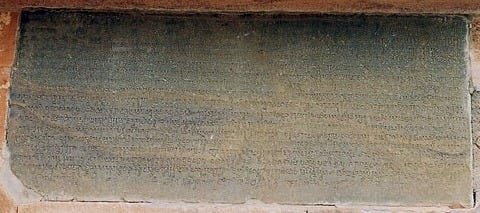
Kalidasa was a court poet in the era of the Gupta Empire sometime in the 4th- 5th centuries CE. While an exact date of his existence cannot be determined, the exact terminus ante quem of his life is evidenced in the Aihole inscription. This was a carved stone wall in the Aihole temple composed by the poet Ravikirti, in which he boasts of his own skills, comparing himself to Kalidasa, and thus confirming that Kalidasa was already a famed name by this time.
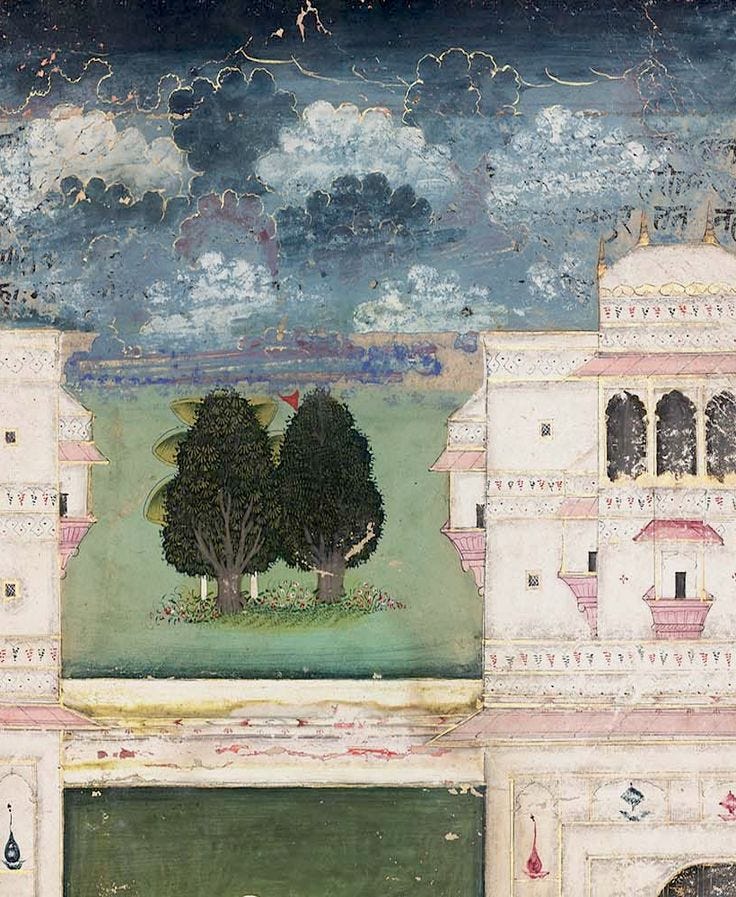
In his poem Meghadhuta, Kalidasa writes of an exiled yaksha. The yakshas were nature spirits who attended to the treasurer god, Kubera. The yaksha is torn away from his wife, who lived in the mythical city of Alaka near Mount Kailash. All good romantic stories (or in this case Sanskrit poems) need yearning. The desperate yaksha begs a cloud resting against a mountain peak to carry his message to his beloved.
Most of the first part of the poem details the cloud’s journey across India, Mount Amrakuta, the crossing of the Narmada river, and wandering through Ujjain and Kurukshetra before moving towards the Himalayas, where Alaka lay with its eternal gardens and divine joy. This somewhat resembles the monsoon clouds that travel across the subcontinent today. Kalidasa describes how the earth rejoices as the cloud passes, blossoming flowers, meandering bumblebees, trees that drink thirstily.
When the cloud finally reached the heavenly city, he found the yaksha’s wife wasted away by grief as she mourned her separation from her husband. The cloud passed the yaksha’s message to her, a reassurance of his deep devotion to her and the promise of his return once his exile ends. The hope of a joyful reunion bolsters his wife and gives her the strength to bear the rest of the exile period.
The English translation I read, I’m sure, does hardly any justice to the beauty of the original. The poem is the pioneer of the genre of the sandesha kavita (messenger poetry in Sanskrit and other South Asian languages) in which a separated lover sends a message to their beloved through a natural element. These elements of longing, desire, and romance surface in Kalidasa’s other work, the Ritusamhara. The Ritusamhara is the poet’s monsoon meditation piece in which he elucidates the ache of the pregnant clouds, the swirling eddy of rain puddles as they reach the earth. Both poems do distinct work. The Ritusamhara creates the atmospheric draw while the Meghadhuta serves the narrower function of creating the lovers who yearn and long and ache during the season, who use the season as a means to reach each other.
But it is not in isolation that these poems fascinate me; it is the cultural traditions he draws on and the subsequent cultural ramifications that hold my interest.
In the Natyashastra, a document penned by Bharata Muni sometime between 200 BCE and 200CE, there is the codification of the navrasa - the nine essential emotions that should be provoked during a performance. The navrasa remains prominent in most classical Indian dance forms even today.
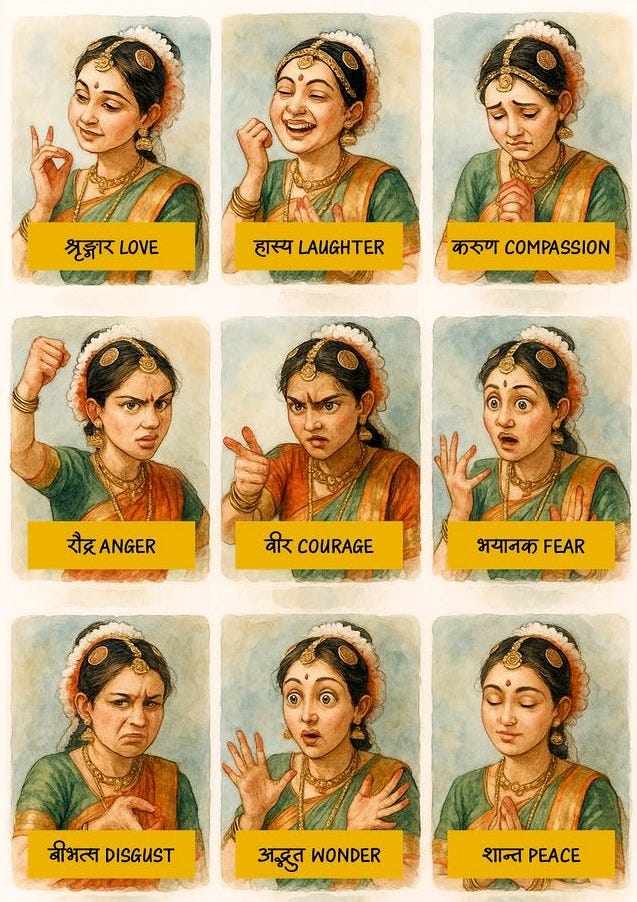
But of the nine emotions, the first - shringara rasa is explicitly defined in the text as arising with specific favourable seasons. Shringara rasa encapsulates all things beautiful - garlands of flowers, sweet melodies, ornaments and gifts and of course the delightful monsoon season. The link between the poetry Kalidasa wrote, where romantic love was heightened during the monsoon, and the genre he is credited with creating is clear because the poet often isolates romantic feelings and amplifies their depth in a monsoon setting. His work gave greater credence to the existing ideas of absence, pining, and longing in romance that arise in the monsoon.
Kalidasa paved the way and after sandesha kavya, other forms of artwork that embodied the relationship between romance and monsoon arose. In the 12th c. CE, Sangita Ratnakara, Sharngadeva allocated rasa to ragas, the songs of classical Indian music. In his work, a Hindu deity is believed to inspire each of the ragas. Lord Shiva finds place in Raga Bhairava, an autumnal Raga; Lord Surya is given Raga Deepak, a summer melody; and Lord Indra, God of Thunder and Rain, is undoubtedly the presiding force over Raga Megh. Each of the six ragas had multiple raginis which were considered wives.
By the late 16th c. CE, Keshavdas’s work - Rasikpriya- explores shringara through the romance of the nayikas and the deities, Radha and Krishna.
Kalidasa remained a prominent figure in this literary-cultural space, setting the precedent for the birth of Ragamala paintings that later rose to prominence during Akbar’s reign, a secular Mughal emperor. It was Akbar who gave these holy paintings royal patronage and thus eternalised them in history.
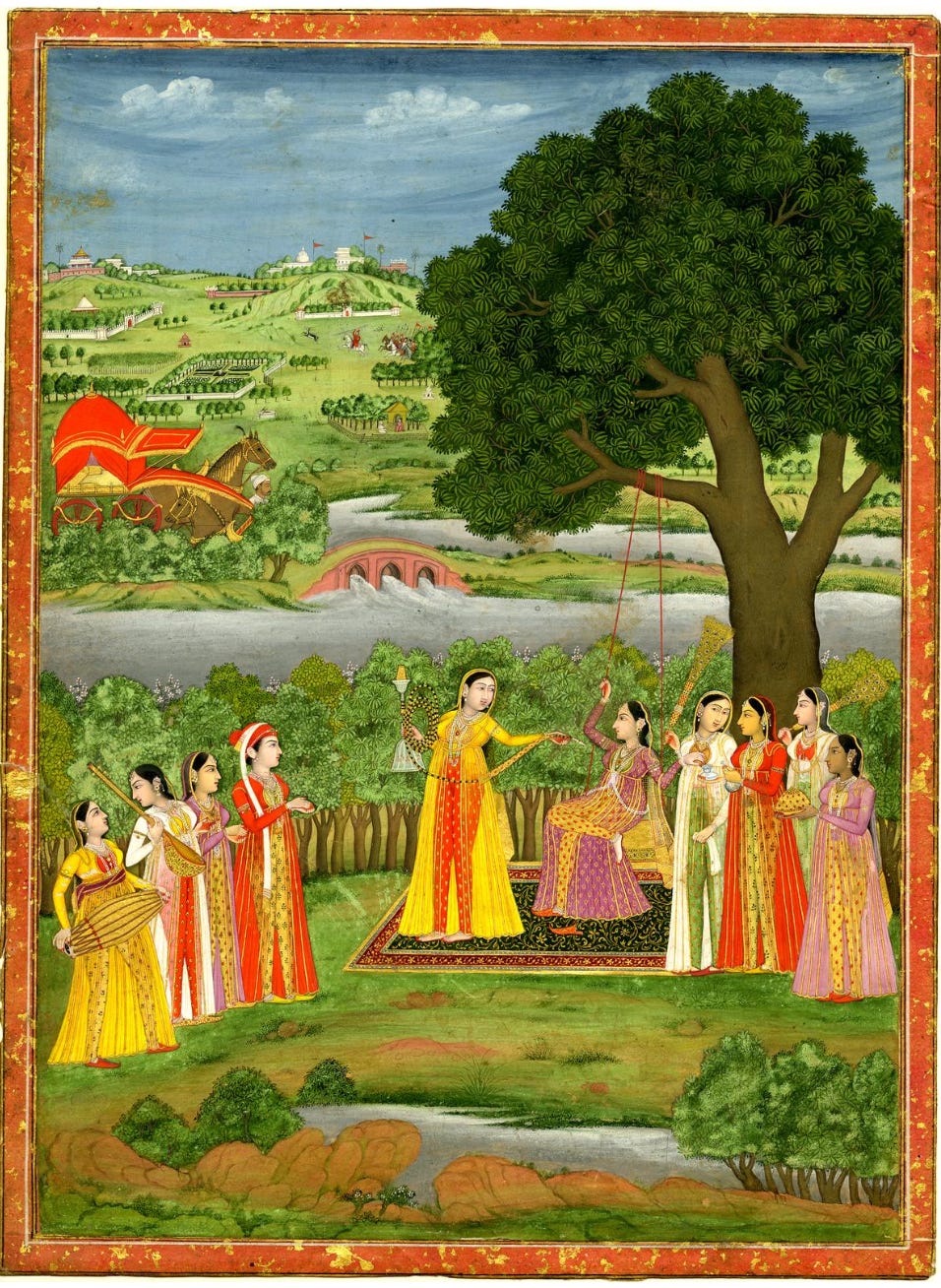
Ragamala paintings are a classical form of miniature paintings that took upon themselves the task of visually translating the melodious ragas of classical music into a visual medium. The ragas take on the role of the male hero and the raginis take on the role of the heroine
Literally translating to garlands of music, musical notes were portrayed as anthropomorphic, human, or divine beings, peacocks, all in the throes of the song's emotion. These ragas would depict Hindu Gods, or a time of day, or a season. Poetry is often delicately painted upon the borders, describing the mood of the painting.
It is the peacocks that always draw most of my attention because they are often the most clear link to Kalidasa. In several Ragamala paintings, art historians believe that the peacocks, who are monsoon birds, are considered to take the place of the beloved. This is especially seen in Kakubha and Kamodini ragini-based paintings. Whether they are messengers like the cloud in Meghadhuta or the actual divine shape of the absent lover, this is the most concrete connection between poem and painting.
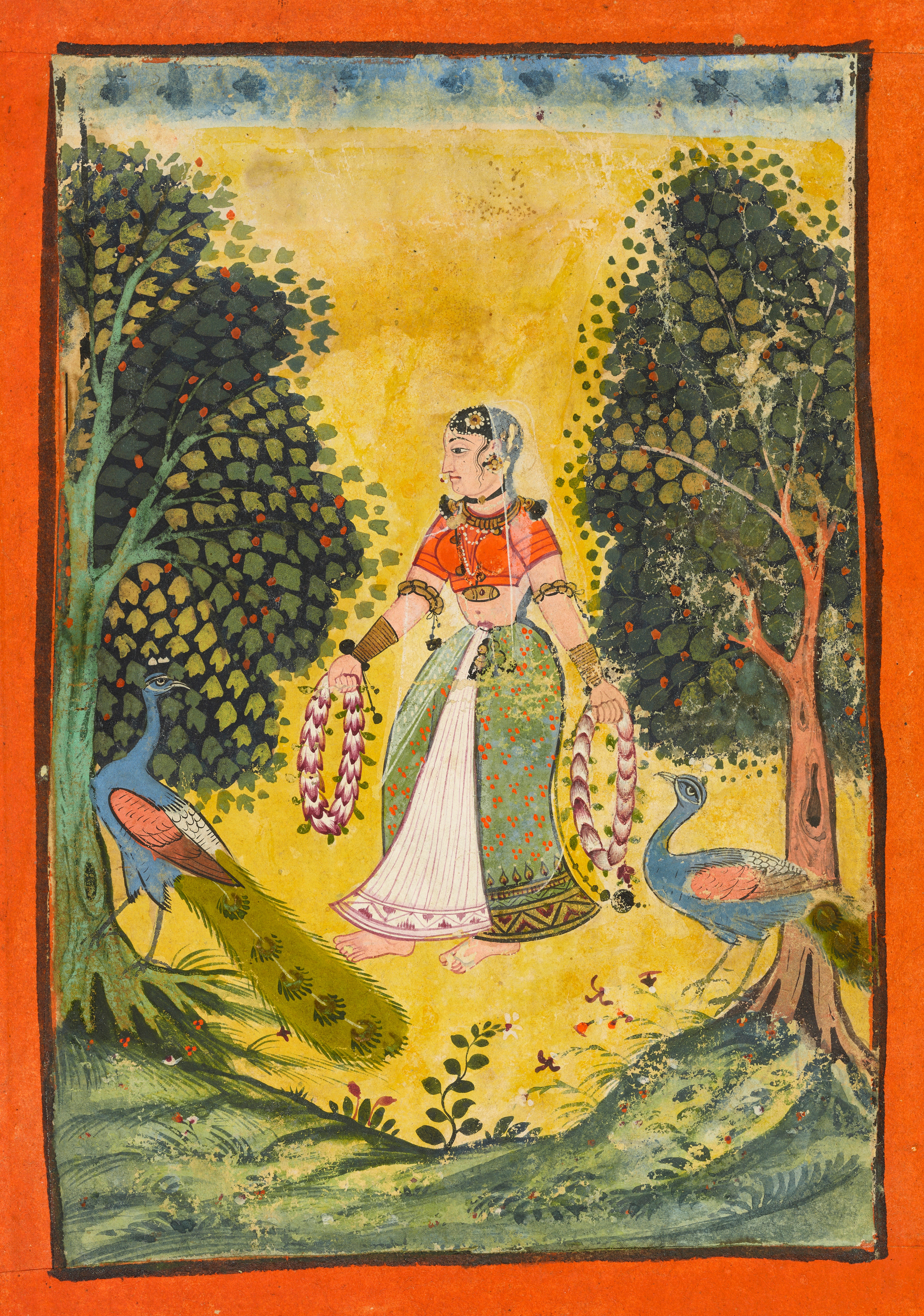
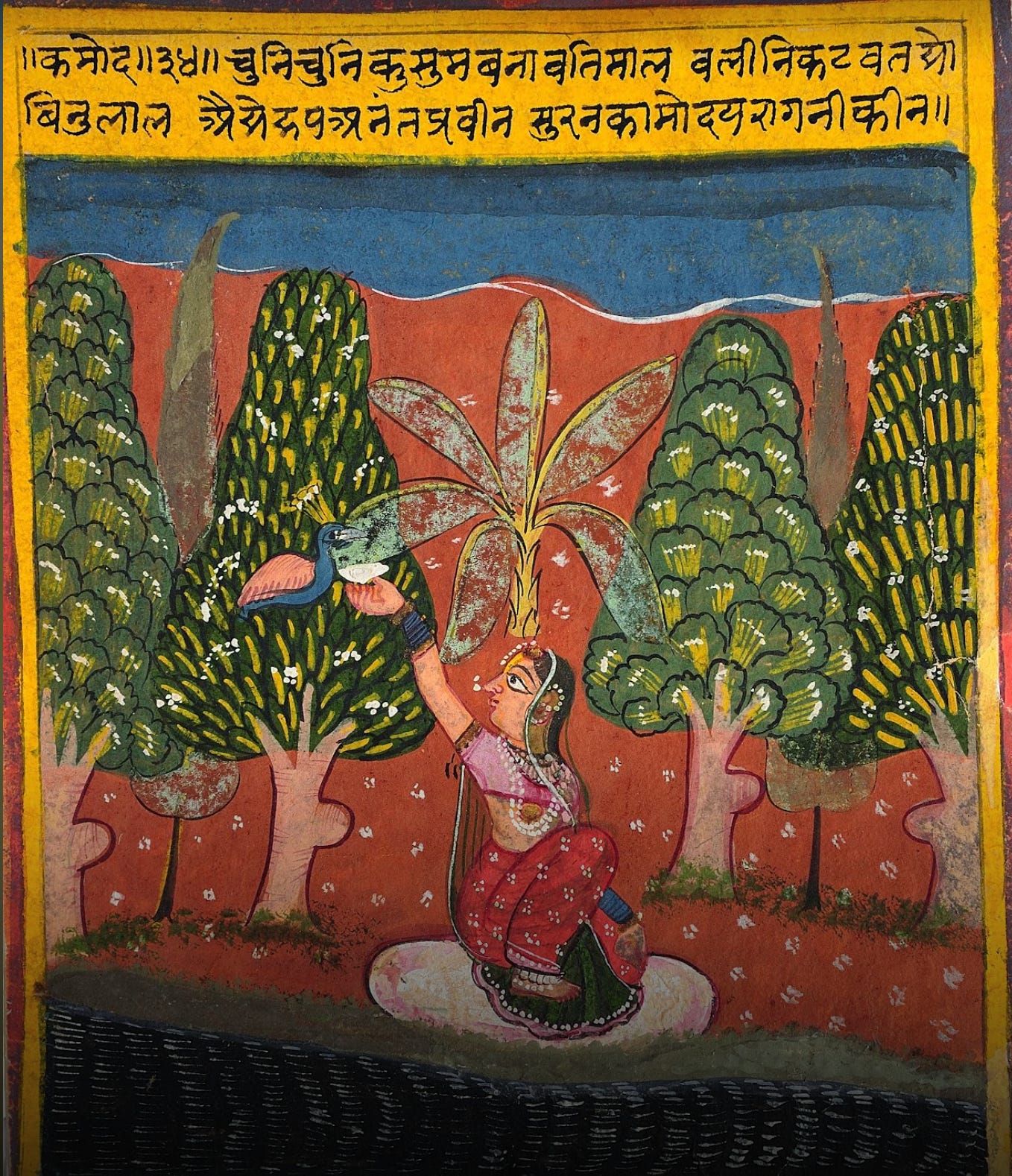
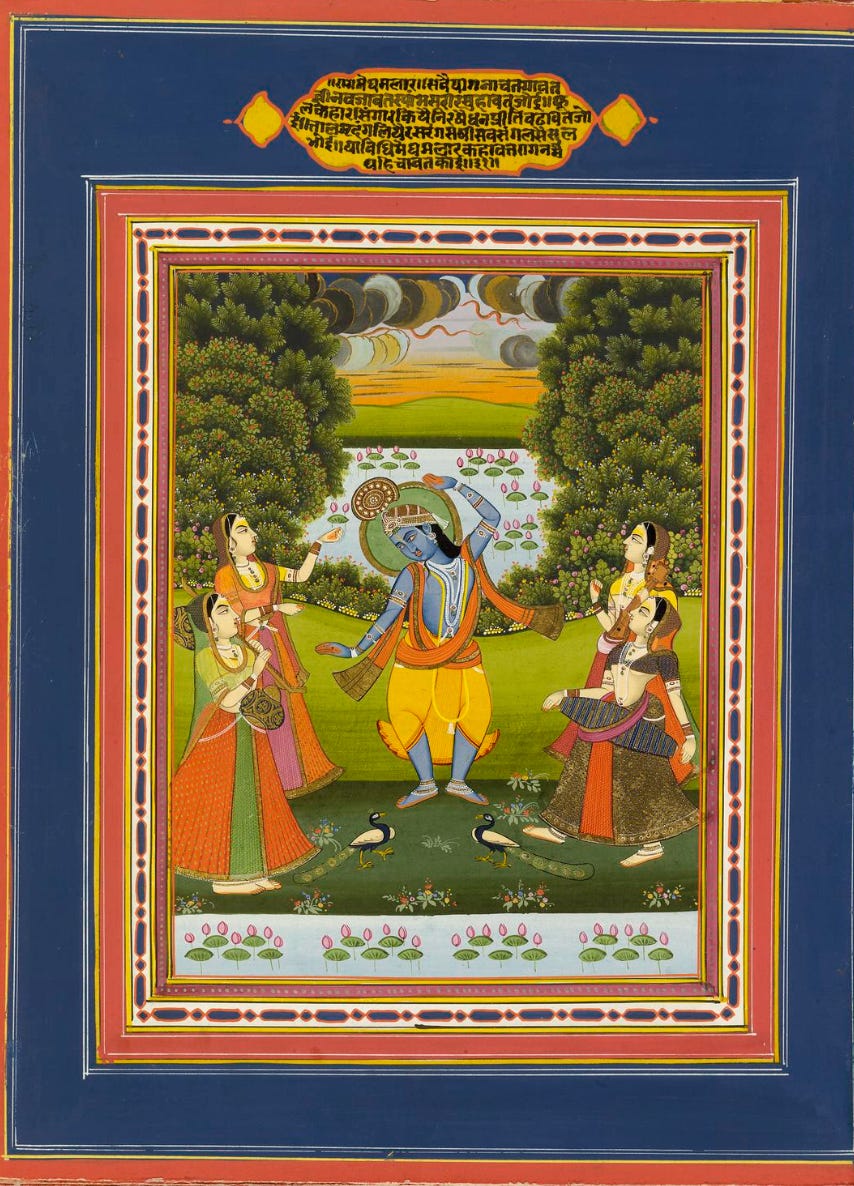
There were a number of different styles across India, but four were most prominent and distinctive in history and each interacted with the monsoon in a different way.
The Rajasthani paintings were characterised by bold warm colours and intense emotions. The painting would feature heavy rain clouds and lightning-charged skies under which Lord Krishna would dance, flanked by peacocks.
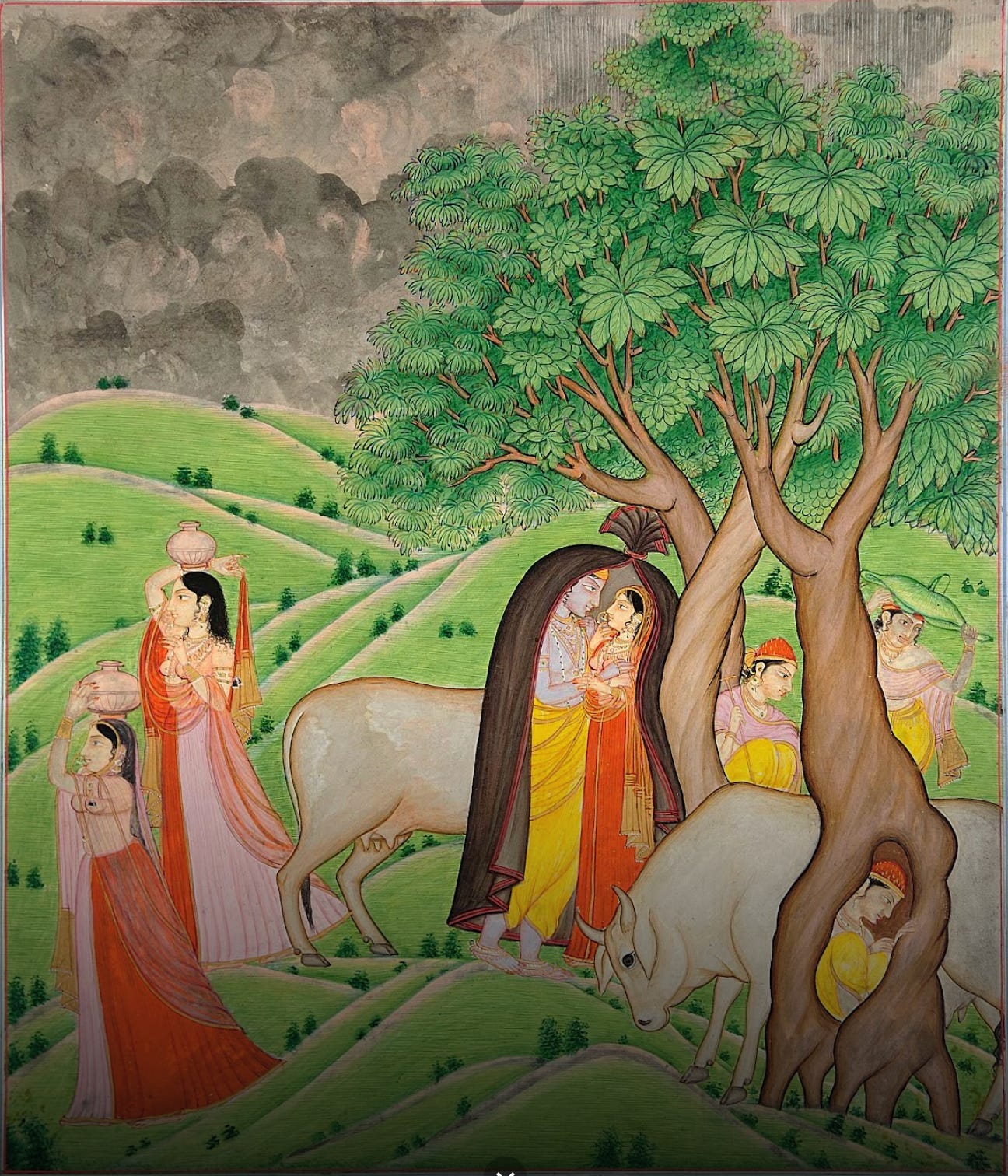
Pahari paintings are primarily romantic and also set the precedent of exploring the emotion of viraha, which was another aspect of shringara. Viraha is a Sanskrit term meaning separation. The most iconic mythological embodiment of viraha is Radha’s longing for Krishna after he leaves Vrindavan for Mathura. This separation becomes the emotional core of the entire Bhakti devotional tradition. Viraha encapsulates the ache of soul-deep yearning.
Deccan-style Ragamala paintings featured starry skies and opulent gold accents. Swirling monsoon clouds are painted with a distinct Persian influence, and the gold leaf is used to highlight lightning.
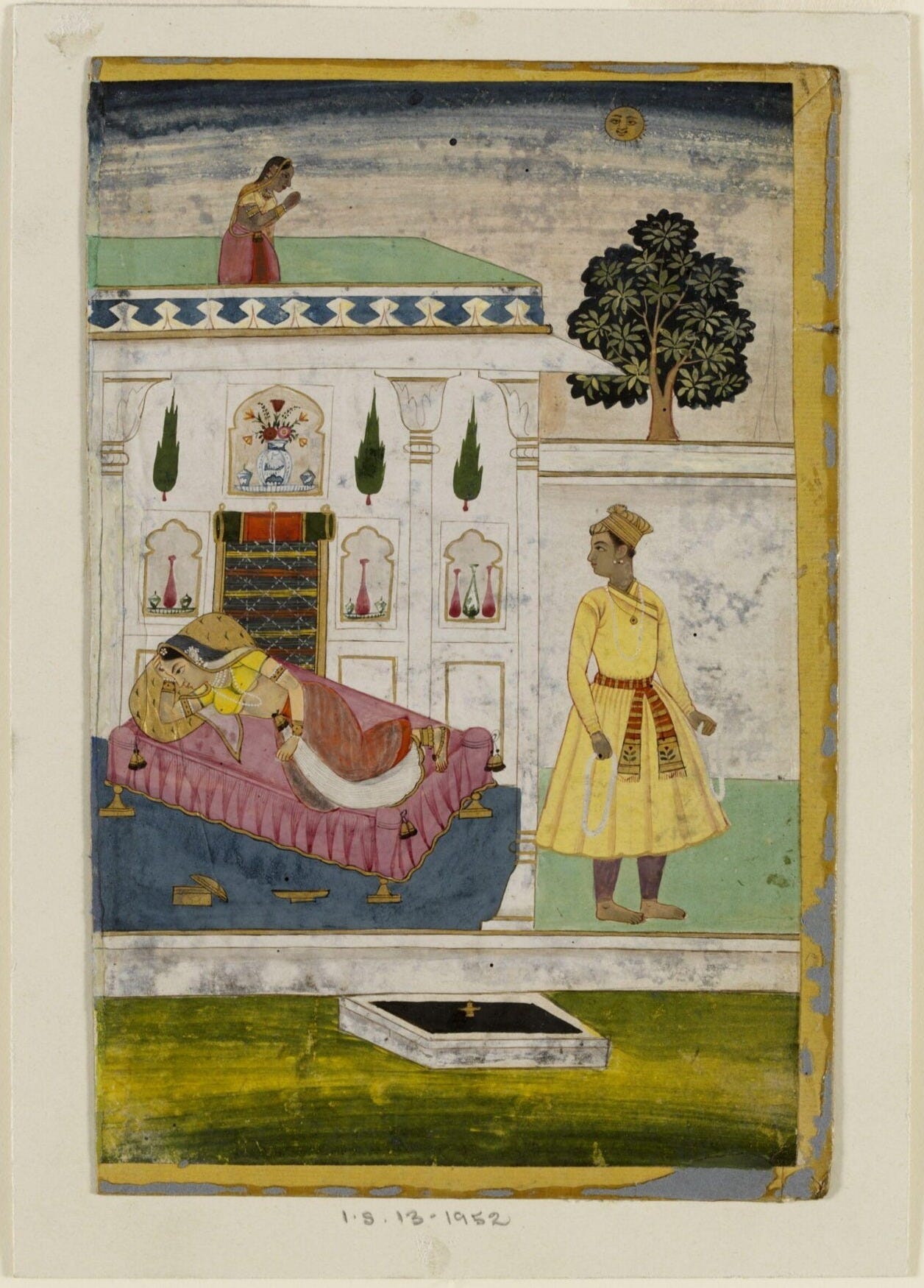
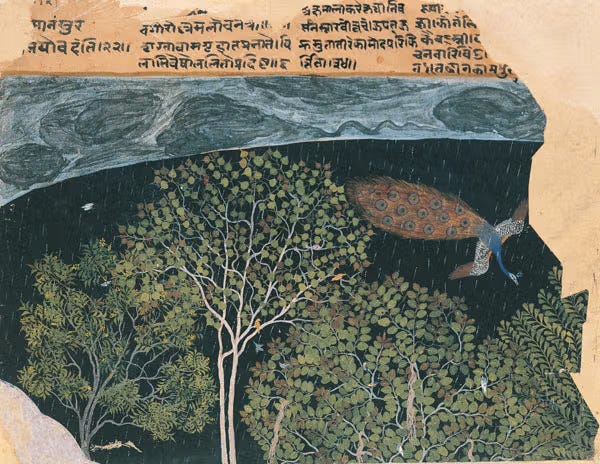
And of course Mughal-style miniatures, which are world-famous for their fine line work and high level of detail, in which the peacock motif is the most common. This is where I find myself most fascinated. Sanskrit Bhakti devotional poetry snaked its way through the subcontinent and found a permanent home in a secular, Muslim ruled court. It’s one of the best ways our country’s culture should be understood, especially today.
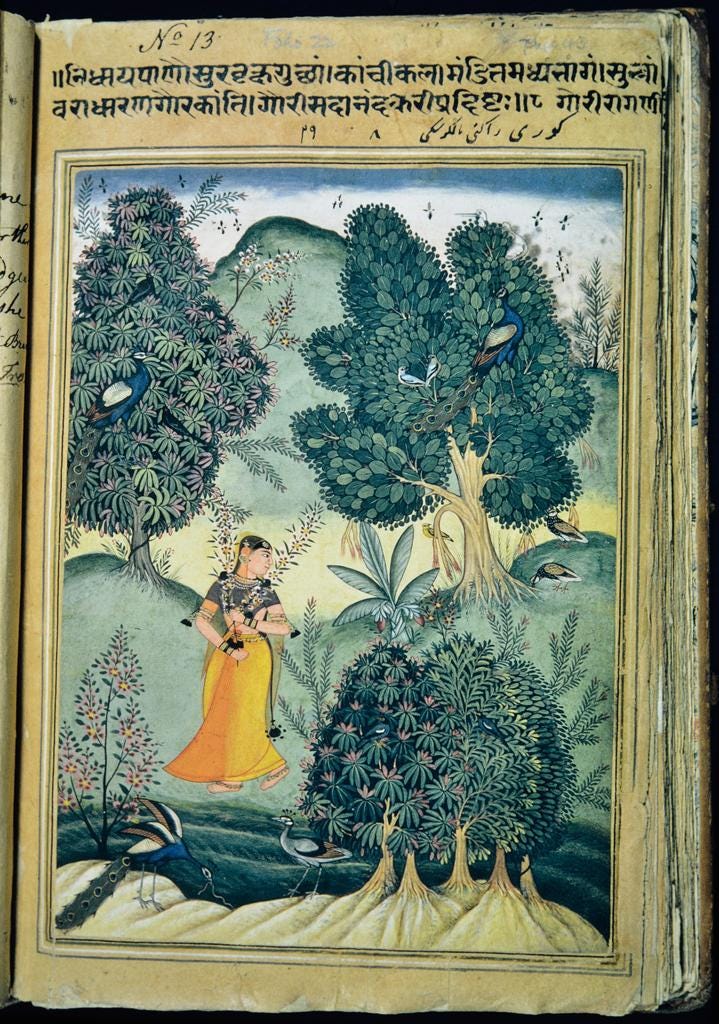
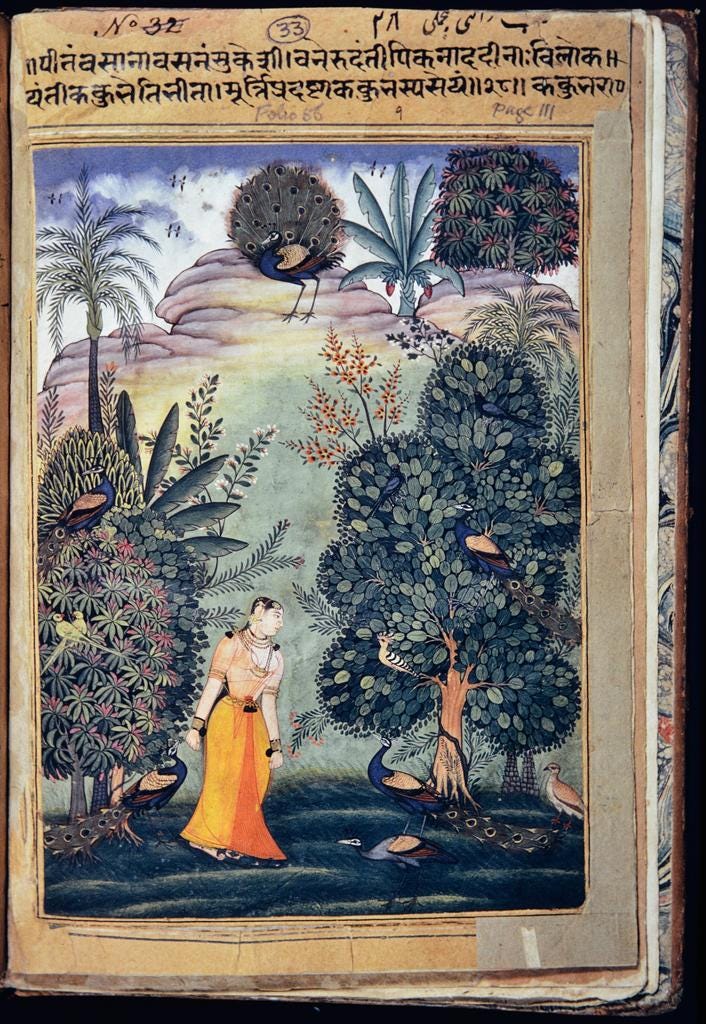
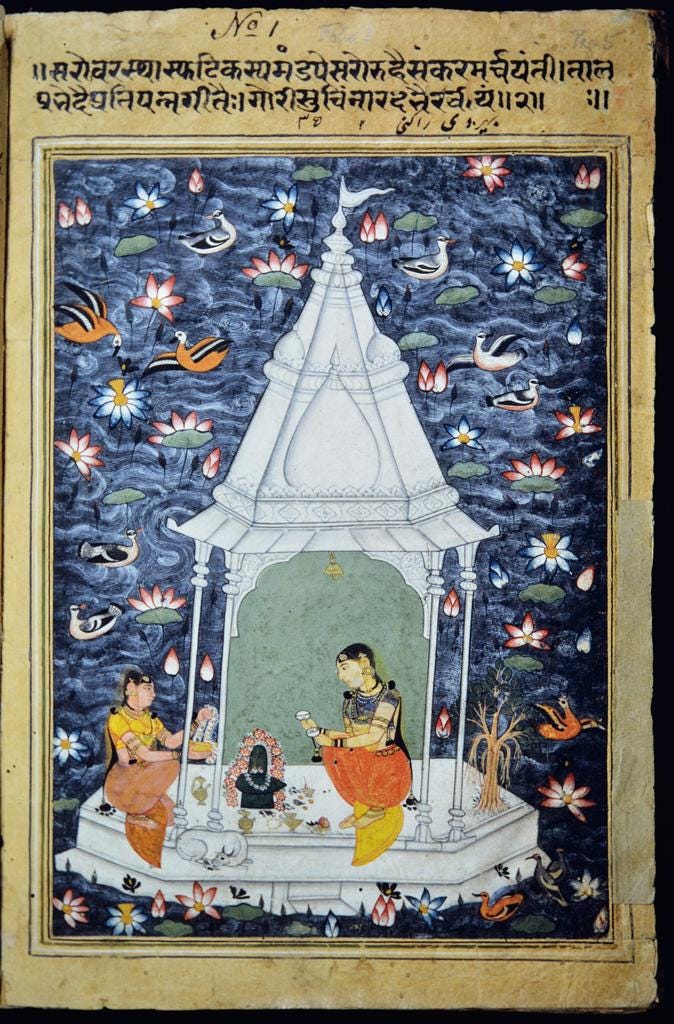
Indeed, these paintings and music were further developed by painters like Ibrahim Ali Shah of Bijapur and the lauded Amir Khusrao. One of our most popular children's folktales now features the Hindu court singer, Tansen, who was one of Akbar’s favourite courtiers. Tansen is able to summon the rain to Akbar’s court by singing Raga Malhar.
Just another one of those interesting syncretic traditions I am reminded of every time it rains. Nothing can bring a diverse group of people together more than the monsoon in India. Often I will stare outside my window as the rain pours, rustling a path through the trees, watching the clouds. There is always one overly fat, lounging cloud that will make its way lazily across the sky, and I can’t help but wonder if there are Gods and yakshas still sending each other love letters when it rains.
Books for further reading:
Ragamala Paintings by Klaus Ebeling
Ragmala Paintings from India by Anna L Dallapiccola, Catherine Glynn, Robert Skeleton
Ragachitra: Deccani Ragamala Paintings by Dr Daljeet
The Loom of Time: A Selection of His Plays and Poems by Kalidasa
Meghadhuta by Kalidasa
Ritusamhara by Kalidasa
Mughal and Rajput Paintings by Milo Cleaveland Beach
The Imperial Image: Paintings for the Mughal Court by Milo Cleaveland Beach
Early Mughal Painting by Milo Cleaveland Beach